
Monday, April 16, 2012

Sunday, April 15, 2012

Changes in the ocean
- Scientists worry about ocean species success due to Increased levels of CO2 impacting living organisms such as shells of muscles. Scientists were able to predict these potential issues because There are muscles living near underwater volcano current and natural high levels of CO2 these changes may be happening too fast for evolution and natural selection
- ocean currently serving as a buffer for temperature change
- coral reefs no longer forming
- Melting of sea ice could lead to a tipping point and increasing ocean temperatures
- Scientist suggests an experiment that student could easily do. Beaker containing water and ice and thermometer of temperature probe, apply heat and record heat over time.
“As governments respond to the aftermath of severe weather events, water and air quality issues, and changes in the way energy is produced, the economic costs to society will be large.” I do not need to look hard, in either location or timing. I have alreading in some of my posts for this course referred to multiple aspects of what might once of been unusual or rare weather events. All of this is written with the complete understanding that what I am writing about is weather; and that decisions about climate require a bigger view.
1. Major flooding in New England multiple times in the past few years.
2. Lack of snow or even cold temperatures in New England this past winter
3. Major storms and tornadoes throughout the U.S. this spring

- water vapor
- carbon dioxide
- methane
- nitrous oxide
Impacts of the greenhouse gases?
1. An important and often overlooked fact about greenhouse gases and the “greenhouse effect” is that without these gases and their impact on the earth lfe as we know it would not be possible.
2. These gases serve as a blanket absorbing and trapping heat and maintaining an average temperature of 59 0 F.
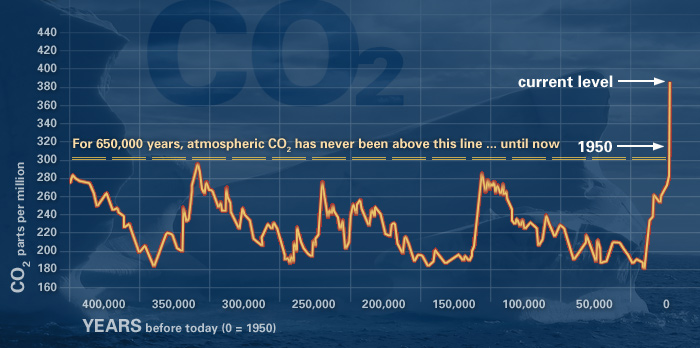
3. Recent concerns stem from increasing amounts of theses greenhouses gases especially those caused by the ever increasing release of carbon dioxide caused by humans burning of fossil fuels.
Thursday, April 12, 2012
Bad news for Ski Areas

As an ardent skier and lover of winter this graphic is heart breaking. It also may be a great attention getter for high school students who have trouble seeing how things might impact them.
Wednesday, April 11, 2012
Overview of Greenhouse Effect/Definitions and Causes
- specific human activities responsible for the increase in four greenhouse gases (carbon dioxide, methane, nitrous oxide, and chlorofluorocarbons
- Of the greenhouse gases carbon dioxide is the one that humans have had the most effect upon. The burning of fossil fuels, which really took off once the industrial revolution is what has lead to an increase in the amounts of carbon dioxide in the earth’s atmosphere and thus to an increase in the amount of heat energy that is trapped into the Earth.
- IPCC has made the claim that climate change is occurring on Earth.
- One important piece of information that kids may have trouble with, it that the proper amounts of greenhouse gases in the atmosphere are essential, with out any the earth would no longer be habitable (with and average temperature of 0 degrees vs. the 59 degrees we have today.
- Most climate scientists agree the main cause of the current global warming trend is human expansion of the "greenhouse effect"1 -- warming that results when the atmosphere traps heat radiating from Earth toward space.
- Think of how you and your classmates may play a role in their increase.
- Certainly student as well as teachers have a big impact simply by looking at car travel and burning of fossil fuels in the production of electricity
- How does evidence shows that current global warming cannot be explained by changes in the sun's energy
- - what is this evidence?
- One of the arguments given by the nay sayers was that the increase in temperature could be caused by increased solar action …unfortunately there is no truth here because the past ten years have been very hot and the past ten years has had low amounts of solar action.
- The series of videos from the NPR site are very good ---I have used these with students in the past and they are very good.
- 1st All about Carbon … as a biology teacher I have always had an affinity toward carbon
- 2nd Making Carbon Bonds…. discussion of the bonds in the carbon of the living things that once buried and fossilized
- 3rd Breaking Carbon Bonds … Energy released once carbon bonds are broken and released to form new bonds at lower energy levels and release energy
- 4th Carbon in Love – carbon a social atom and the molecule is happiest with is oxygen. Some of the carbon dioxide are used by plants and some are deposited in the oceans but increasing amounts are released into the atmosphere
- 5th What do we do? – possible solutions carbon sequent ion or we can learn to release carbon
Tuesday, April 10, 2012
So have my high school seniors already made up their minds about climate change?
So have my high school
seniors already made up their minds about climate change?
In Chris Mooney’s article “The Science of Why We Don’tBelieve Science” he discuss multiple examples of science that is backed up by
the preponderance of evidence but still has its distractors. I think I got the point after the first page,
actually I did find it interesting that he thought more pieces of evidence he
gave the better would be his argument, when his point is that even with all the
evidence people still believe what they want to believe. Don’t confuse me with
the facts I have already made up my mind. Today I surveyed my students today and
it certainly looks like many of them already have some strong feelings as well
as some significant misconceptions. The research I have done on misconceptions
tells me that kids need to acknowledge and work with their misconceptions
before any movement is possible. They have to be given significant reasons to
give up those misconceptions and replace these ideas with correct knowledge.
Sunday, April 8, 2012
When the Extremes Become the Means (Pilot)
After a quick read through …I have chosen “When Extremes
become Means”. Just in our local area of
New England we have had numerous “100 year” weather events in the past few
years. Melting glaciers and shifting weather patterns are important and
significant to learn about; but experience has shown me close to home is a good
way to start.
Friday, April 6, 2012
So What's Up with this Climate Change Stuff
NASA has been an import source of research and probing, investigating and
asking questions about both Earth and
our relationship to other planetary objects,which has provided an abundance of
evidence of climate change. NASA is responsible for the many satellites
constantly traveling overhead recording both incoming and outgoing radiation,
as well as measuring greenhouse gases. As stated in the short video, solar
activities are an activity that can have changing impacts on the incoming
radiation levels, but these are not the cause of this increase (we are
currently in the hottest decade in recorded time) because it has been a decade
of low solar activity. When I have taught lessons about climate change in the
past I have found that students have a tough time conceptualizing albedo or the
reflective quality of different surfaces. It is not a black and white issue. I
think one of the scariest parts of this whole issue is the idea that when ice
is lost and turns to water we go from a white very reflective substance to a
dark absorbent substance. And then there
are clouds which are reflective, but are composed of water vapor (which is a
major greenhouse gas). So I guess I am
not surprised that students have issues with these understandings. The vast
amount of evidence continues to indicate that climate change is real and it has
been caused by us.
Thursday, April 5, 2012
Wednesday, April 4, 2012
 As we move into this new century, many of the things
we have been hearing in education are coming together. The job of a teacher is
certainly not getting easier, and many folks would argue it is getting harder. Any teachers who have looked in the press for
good news are met with report after report stating just how deficient our students
are. So what can we do? The press is equally full of suggestions on how to fix
things. The Partnership for the 21st Century lists skills such, critical
thinking, problem solving, communication and collaboration. If you “Google” 21st
century skills and learning there are many sites, with lots of similar lists,
all designed to demand more of today’s students. STEM education is the new hot
term and movement in science teaching. This winter’s Science Teacher published
two issues that discussed the new push to revamp and energize science teaching
in the U.S. . In addition to that publication this site has lots of valuable
information.
As we move into this new century, many of the things
we have been hearing in education are coming together. The job of a teacher is
certainly not getting easier, and many folks would argue it is getting harder. Any teachers who have looked in the press for
good news are met with report after report stating just how deficient our students
are. So what can we do? The press is equally full of suggestions on how to fix
things. The Partnership for the 21st Century lists skills such, critical
thinking, problem solving, communication and collaboration. If you “Google” 21st
century skills and learning there are many sites, with lots of similar lists,
all designed to demand more of today’s students. STEM education is the new hot
term and movement in science teaching. This winter’s Science Teacher published
two issues that discussed the new push to revamp and energize science teaching
in the U.S. . In addition to that publication this site has lots of valuable
information.
Problem Based Learning (PBL) and other similar
project type learning projects are useful and connected to deep meaningful
learning. The connection here is that the goals of PBL; are clearly more aligned
with the skills listed above them are traditional, kids in rows and teachers in
front of the class more traditional education models.
After a quick read through of the new standards, the
biggest difference I see is the more obvious stress on technology and the
inclusion of technological solutions as a major part of science. I think there
was a time when science teachers thought they dealt in the realm of “pure
science” and that the application the technology was below that. My sense is
that the inclusion of technology and the doing of science will be well received
by students. After reading the supplied information about NASA especially the
line “"U.S. scientific, security, and economic interests through robust
space exploration and aeronautics research programs", my brain goes back
to the 60 minute episode I watched this week.
Sixty Minutes End of Shuttle Program Sixty Minutes End of Shuttle Program There has always been a connection between NASA and science education. My grade school years were all about out race with the Soviet Union to be ahead in manned space. Spending money in public & higher education programs was deemed important. Lets hope the promises make to NASA are kept.
New Web 2.0 Tools
Which Web 2.0 tools did you explore and how might they be used in the classroom to promote communication and/or reflection?
I remembered a workshop I went to last month and a web site suggested there. This site
a site for finding web 2.0 tools.
 One of the most useful thing about this site is that one of the ways you can sort is to find free applications. In the past I have had issues with tools that were once free being changed to fee based applications.
I remembered a workshop I went to last month and a web site suggested there. This site
a site for finding web 2.0 tools.

Web 2.0 and the student. I find all this much more exciting when a bunch of teachers are in a room discussing all the wonderful things they can and will do. "This is great we will finally get our students to collaborate in deep meaningful ways!" I remember two years ago when I found out about social book marking sites, such as , I thought to myself, this is fantastic the kids will buy in. But no ...I have been very frustrated whenever I ask kids to use the web to do our work. Right now I have an Anatomy class that I have asked to use a wiki to present/share information about books individual students have read. I am amazed at the amount of complaining I have gotten. Overwhelming agreement that they would rather just do a paper book report.
, I thought to myself, this is fantastic the kids will buy in. But no ...I have been very frustrated whenever I ask kids to use the web to do our work. Right now I have an Anatomy class that I have asked to use a wiki to present/share information about books individual students have read. I am amazed at the amount of complaining I have gotten. Overwhelming agreement that they would rather just do a paper book report.
Subscribe to:
Comments (Atom)